The way software gets priced is undergoing its most dramatic shift since the birth of SaaS. Here's what every B2B software company needs to understand, and do about it.
There's a question every SaaS leader is quietly wrestling with right now: if AI can do the work of ten users, why are we still charging per seat?
It's not rhetorical. It's the central challenge of AI monetization. How you answer it will define your competitive position for the next decade.
AI isn't just a feature upgrade. It's a structural change to what software does, who uses it, and how value gets created. The companies that recognise this early and redesign their monetization models accordingly will capture significantly more of the value they create. Those that don't, risk finding themselves in a slow-motion pricing trap: their AI works brilliantly, their costs climb, and their revenue stays stubbornly flat.
Why AI Monetization Is Different From Traditional SaaS
Traditional SaaS monetization was built on a simple premise: more users equals more value. You charged per seat because every human who logged in represented genuine incremental usage and adoption. The economics made sense. Serving one more user cost virtually nothing.
AI breaks both of those assumptions at once.
The value equation has changed. When AI can handle tasks previously done by a team of people, per-seat pricing actively penalises your best customers for getting value from your product. For example, if AI can handle a sizeable proportion of customer support, companies will need far fewer human agents, and therefore fewer software seats. The pricing model starts working against you.
The cost structure has changed. Unlike traditional SaaS, where marginal cost per user trends toward zero, every AI inference, every agent action, every model call has a real cost attached to it. AI companies are seeing gross margins of 50–60%, compared to 80–90% for traditional SaaS. This isn't a temporary growing pain. It's the new economics of the category, and it means pricing has to be treated as a financial discipline, not just a commercial one.
The buyer's expectations have changed. Enterprise customers who once happily paid for access to a platform now want to pay for results. McKinsey's research across 150 global AI software vendors found that only 30% have published quantifiable ROI from real customer deployments. Yet, demonstrating concrete value has become the primary barrier to wider AI adoption and monetisation. Buyers are increasingly asking: what did I actually get for this?
The result is a market in transition. As McKinsey observed in their landmark 2025 analysis of AI software business models, as AI products increasingly perform work rather than merely support it, the new era calls for business models that align customer value with units of work completed.
The Four Pricing Models Reshaping the Market
There's no single right answer for AI monetization! But there are four models that are emerging as the dominant frameworks. Understanding each, and knowing when to use them, is essential.
1. Seat-Based (Per User)
The familiar model. Customers pay a fixed fee per user, per month or year.
When it still works: Seat-based pricing isn't dead, it's just no longer the default. It still makes sense when your AI behaves like a productivity assistant helping individuals work faster, rather than replacing tasks entirely. Think of it as appropriate when AI augments users rather than substitutes for them.
The risk: If your AI genuinely reduces the number of users a customer needs, seat-based pricing creates a direct conflict of interest. The better your product works, the more it erodes your own revenue. Sierra, the AI customer experience platform, explicitly built their model around outcome-based pricing precisely to avoid this trap. Legacy providers charging per seat have a built-in incentive to limit how effective their AI actually becomes.
2. Usage-Based (Consumption)
Customers pay based on what they actually consume, e.g. API calls, tokens, tasks completed, compute resources used. This is how AWS, Snowflake, and the major LLM providers price their infrastructure.
When it works best: Usage-based models are well-suited to products with variable consumption patterns, where some customers use far more than others. They also align well with AI's variable cost structure. When your costs scale with usage, it makes sense for your revenue to scale the same way.
The tradeoff: Unpredictability. Buyers used to fixed SaaS contracts can find usage-based billing hard to forecast and budget for. This is one reason why pure usage-based models are often combined with a subscription floor.
McKinsey's data is striking here: the number of consumption-based software companies more than doubled between 2015 and 2024. This isn't a trend, it's a structural shift.
3. Hybrid (Subscription + Usage)
A base subscription provides predictability for the customer; a usage or consumption layer captures upside as customers scale. This is the model that McKinsey found most commonly adopted among companies successfully navigating the AI transition, and it's where many mature SaaS businesses are landing.
HubSpot uses this approach: AI-powered features like lead scoring are included in higher tiers, with additional consumption available in structured "buckets." Zendesk charges per human support agent seat and per AI-resolved ticket. Both approaches give customers a predictable baseline while aligning incremental revenue with incremental value.
Why hybrid often wins: It balances two competing needs, the customer's need for budget predictability, and the vendor's need to capture the economics of AI at scale. Hybrid models are especially effective when you're uncertain which metric best captures value, because they provide customer predictability while capturing upside as they scale.
4. Outcome-Based (Pay for Results)
The most radical, and fastest growing model. Customers pay only when the AI delivers a defined, measurable result. No outcome, no charge.
Intercom's Fin AI agent charges $0.99 per resolved support ticket. If the issue isn't resolved, there's no charge. Sierra prices on successfully completed customer interactions. Zendesk, in a landmark move in 2024, became the first major CX provider to offer outcome-based pricing for AI agents.
Why this model is gaining traction: It creates genuine alignment between vendor and customer. The vendor's incentive is to make the AI work as well as possible, because that's the only way they get paid.
The challenge: Outcome-based pricing requires clear, agreed-upon definitions of what constitutes a "result," robust measurement infrastructure, and a willingness to absorb cost variability. Attribution can get complicated! For example, what happens when multiple factors influence an outcome? These are solvable problems, but they require operational maturity.
Choosing the Right Model: The Attribution-Autonomy Lens
One useful framework for navigating these choices is to think about how autonomous your AI actually is, and how attributable the value it creates is.
An AI copilot that suggests next actions to a human sales rep is low-autonomy and loosely attributable! The human still makes the final call, and it's hard to separate the AI's contribution from the rep's own judgment. A fully autonomous agent that books meetings, resolves tickets, or processes documents without human input is high-autonomy and highly attributable.
Generally speaking: the more autonomous and attributable your AI, the stronger the case for outcome-based pricing. The less autonomous and attributable, the more you may still need a seat or subscription foundation.
(We explored this in more depth in our AI Monetization Workshop — see the summary here.)
The Market Is Moving. Act Now.
Understanding the landscape is one thing. But the most important message from every AI monetization conversation we've had with SaaS leaders in the past year is this: stop deliberating and start doing.
In workshops with dozens of SaaS teams across the market, the overwhelming consensus landed in the same place:
Add credits to your existing offering today, then let real usage data tell you where to go next.
It sounds almost too simple, but it's the move that's working.
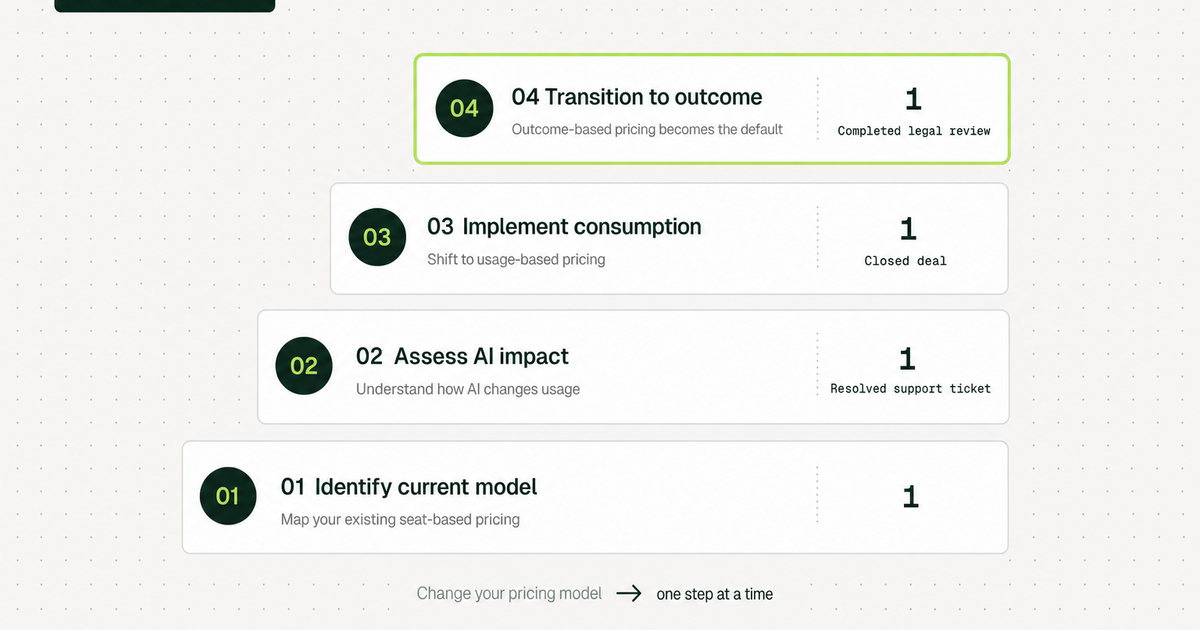
Credits bridge the gap between your current seat-based model and the outcome-based future. They give customers a tangible unit of AI value that maps to actions and outputs, without requiring you to solve the attribution problem on day one. They introduce the concept of consumption to your buyer relationship, creating the data foundation you need to understand how your AI is actually used. And critically, they're already the predominant model in the market. The companies that made this move 12 to 18 months ago are already seeing the results: higher expansion revenue, cleaner usage signals, and customers who understand what they're paying for.
The trajectory from here is reasonably clear: credits today, outcomes tomorrow. Once you have enough usage data to confidently define what a "successful outcome" looks like in your product, you have everything you need to make the transition to outcome-based pricing, if and when that makes sense for your segment.
What you shouldn't do is wait for a perfect model before moving. The pricing architecture of the AI era is being invented in public, right now. Every month you spend on your existing model is a month your competitors are learning what works. The companies that will own this transition are the ones building usage intelligence today. Not the ones who plan to start next quarter!
If you're an established SaaS company: add a credit layer to your current plans this quarter. Instrument your AI actions. Watch how customers consume. Then iterate.
That's not a compromise. That's the strategy.
How Can Paid Help?
There's a gap at the heart of AI monetization that most companies don't see until it's costing them. Your AI agent makes tool calls, burns tokens, processes records. That's the usage layer, and it's what your engineers understand. But your buyer doesn't care about tool calls. They care about: what did this thing actually do for me?
Usage → Value → Dollars. That's a two-step translation, and almost every SaaS company today is skipping the middle step.
Paid is built to close that gap. It's the infrastructure layer that takes raw agent activity (the egress, the signals, the LLM calls), and converts it first into human-comprehensible value (hours saved, revenue influenced, risk avoided), and then into a pricing mechanism that turns that value into revenue.
The platform is built around four pillars:
Observe. Get complete visibility into what your AI agents are doing and how. Before you can monetize effectively, you need to see exactly where value is being created. Which actions, which workflows, which agent behaviours are driving real outcomes for your customers. Paid gives you that signal.
Monetize. Once you can see the value your agents are creating, Paid gives you the controls and tooling to turn that insight into pricing decisions. Whether you're moving to credits, building toward outcome-based models, or running a hybrid, Paid helps you configure the pricing mechanics that maximise your revenue without guesswork.
Analyse. Understanding what your AI delivers is only valuable if you can communicate it to your customers, your board, and your sales team. Paid's dashboards surface the evidence of work and evidence of value your product is creating, in terms that buyers understand and that drive retention and expansion.
Bill. Pricing decisions are only as good as your ability to execute on them. Paid integrates directly with your billing infrastructure, so the model you design is the model that runs. No manual reconciliation, no engineering overhead, no gap between what you've promised customers and what actually appears on their invoice.
The companies that win the AI era won't just build better agents. They'll be the ones who can articulate, programmatically and in real time, the value those agents are delivering, and price for it accordingly. That's not a billing feature. That's infrastructure.
Want to go deeper on how to choose the right monetization model for your AI product? Read our AI Monetization Workshop summary → Here
Stay ahead of AI pricing trends
Get weekly insights on AI monetization, cost optimization, and billing strategies.
Monetize AI Without the Headache
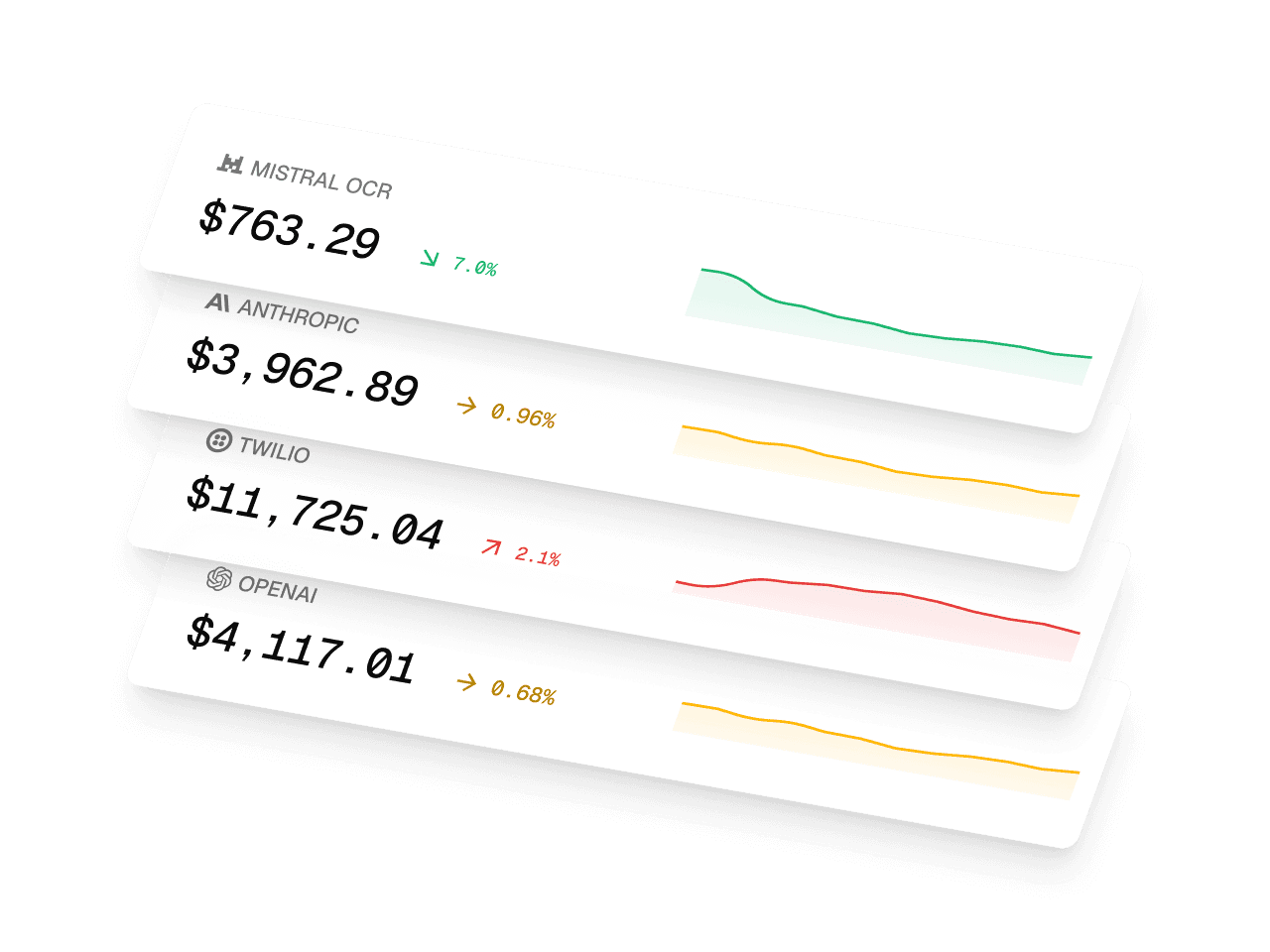
The billing platform built for AI companies. Launch pricing models, track costs, and optimize margins—no engineering lift.
- Track AI costs by model & customer
- Launch usage-based pricing fast
- Know your margin on every deal
- Integrate in minutes