There is a dynamic that plays out in almost every enterprise software deal, and it costs vendors more than they realise.
You close the contract. The customer deploys to a subset of users. They call it a pilot. Six months later, you are still fighting to get the rest of the organisation on the platform. Your CS team is running business reviews trying to prove value. Your AE is trying to expand a deal that should have landed wall-to-wall from day one.
This is not a CS problem. It is not an onboarding problem. It is a pricing structure problem. And outcome-based pricing is how you fix it.
What is outcome-based pricing?
Outcome-based pricing is a commercial model where customers pay for measurable business results rather than for access to a platform or a number of seats. Instead of paying a fixed fee per user per month, the customer pays when the product delivers a defined outcome, such as revenue growth, pipeline generated, or cost avoided. The vendor gets paid when the customer wins. That alignment is the entire point.
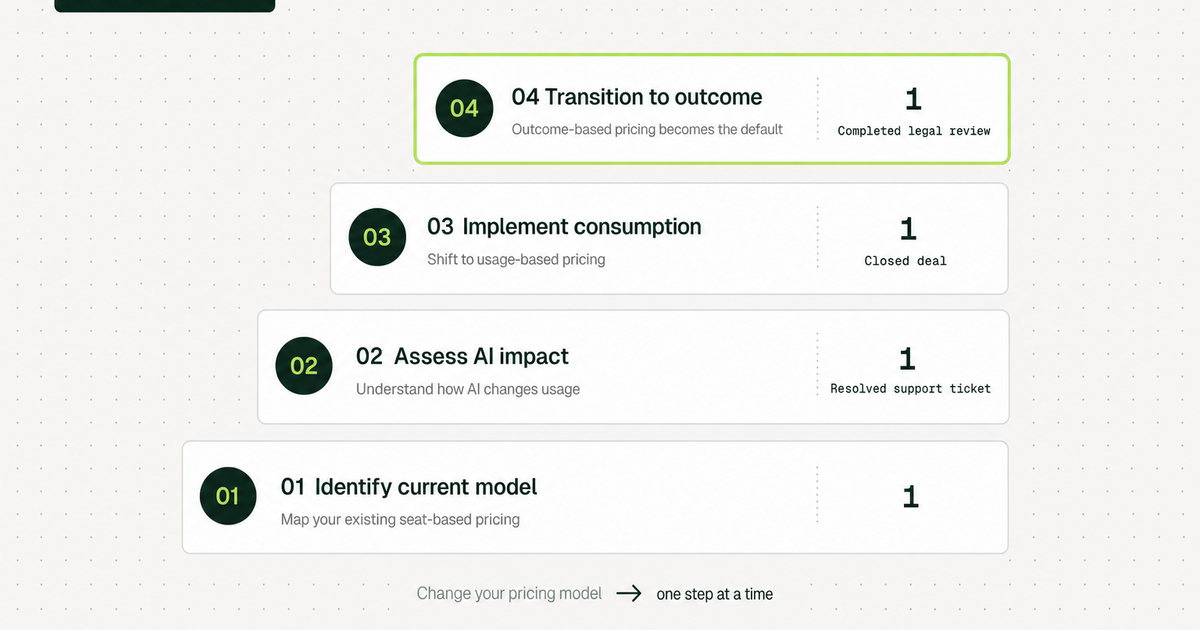
It sits at the far end of the pricing spectrum from seat-based SaaS. Usage-based pricing sits in the middle, charging for consumption of the platform rather than for a fixed headcount. Outcome-based pricing goes one step further: it ties the commercial relationship directly to the business result the customer actually cares about.
Why seat-based pricing works against you
The moment you price by seat, you set up a negotiation that is structurally adversarial. You want more seats. The customer wants to control headcount on the contract. You are pulling in opposite directions before the ink is dry.
And even when you win that negotiation, you have not won adoption. A customer who bought 50 seats will deploy to 50 people and stop there, regardless of whether another 200 people in the organisation would benefit. The pricing model has given them no reason to go further.
We see this pattern repeatedly across the companies we work with at Paid. The tool gets used by the team it was sold to. The rest of the business never touches it. Renewal comes around and the customer cannot articulate the value, because half the platform was never activated.
The issue is not the product. The issue is that the commercial model created no forcing function for full deployment.
What changes when you price on outcomes
When a customer commits to paying for a business outcome rather than access to a platform, their incentives flip completely.
They are no longer a passive buyer waiting to be convinced. They are a partner with skin in the game. They need the platform to work. That means they push internal adoption themselves. They clear the blockers that would otherwise take you quarters to get through. They show up to enablement sessions.
Jason Eubanks, founder of Aurasell, ran straight into this when a large enterprise customer came to the table during contract negotiations and asked to pay for outcomes rather than seats. The first conversation about what "outcome" actually means was instructive.
The customer's early suggestions were functional, not commercial. Things like a connected call over 45 seconds on the dialer. Eubanks pushed back immediately. That is not a business outcome. That is just the product working as advertised.
They landed on revenue growth as the metric that actually mattered. Every team touching the revenue process runs inside Aurasell, from the first inbound lead through to closed deal and customer onboarding. If the platform is driving the revenue process, then revenue growth is the right unit of accountability. The customer agreed. They built a deal around a platform fee plus revenue growth.
The result was not what you would expect from a complex enterprise deployment. A company with thousands of sellers was fully onboarded in three months.
Not because implementation was easy. Because the customer was pulling, not being pushed. They had every reason to make it work fast.
To hear the full story, links to the episode with Jason Eubanks are at the bottom of the page.
The adoption insight nobody talks about
When you take accountability for an outcome, you can demand that the customer uses the entire platform to deliver it. That is not an aggressive ask. It is a logical requirement. You cannot be accountable for revenue growth if only one team is using the tool. The outcome model gives you the commercial standing to insist on wall-to-wall deployment.
Think about what that means in practice. Outcome-based pricing is not just a billing model. It is a go-to-market forcing function for full platform activation.
This is the conversation the industry has been having backwards. Everyone asks: how do we get customers to adopt the full platform? The answer is not better onboarding. It is not more customer success headcount. It is aligning the commercial structure so that full adoption is in the customer's interest, not just yours.
The objection you will hear
Six months ago, when we first started talking to go-to-market software companies about outcome-based pricing, the pushback was consistent: customers still want to buy seats. You try to move them and they come back to seats.
That was true. It is less true now, and it is moving fast.
Enterprise buyers are increasingly the ones initiating this conversation. They are coming to the table asking to pay for results. The companies that have built the infrastructure to say yes to that question are closing bigger deals, landing faster, and getting to full deployment in months instead of years.
The companies still insisting on seat-based contracts are leaving both money and adoption on the table.
What outcome-based pricing requires from you
Outcome-based pricing is not something you can bolt onto an existing commercial model. It requires three things.
First, your product needs to be running the customer's core workflows, not sitting on the edge of their process. Eubanks could tie his commercial model to revenue growth because every team touching revenue was operating inside the platform. That is not an accident. It is a product strategy decision made long before the sales conversation.
Second, you need to agree on a metric that is genuinely attributable to your product and genuinely meaningful to the customer. Not a proxy metric. Not a functional output. A business outcome they already care about and already measure.
Third, you need the billing infrastructure to support a commercial model that does not look like a standard SaaS contract. Variable structures, revenue-linked fees, and consumption layers all require tooling that most finance and revenue teams are not set up for today.
This is exactly the infrastructure Paid is built to support. The shift from seats to outcomes is not a philosophical change. It is an operational one. And the companies building for it now will be running wall-to-wall deployments while everyone else is still fighting for seat expansions.
Frequently asked questions
What is the difference between outcome-based pricing and usage-based pricing?
Usage-based pricing charges customers for how much of a platform they consume, such as API calls, tokens, or tasks completed. Outcome-based pricing goes one step further and ties the fee to a measurable business result, such as revenue generated, pipeline built, or cost avoided. Usage-based pricing aligns cost with activity. Outcome-based pricing aligns cost with value.
Does outcome-based pricing work for enterprise software?
Yes, and enterprise is increasingly where the demand is coming from. Large buyers with complex deployments are asking to pay for results rather than seats, because they want commercial accountability from their vendors. The challenge is that it requires clear outcome definition, strong attribution infrastructure, and billing tooling built for variable commercial models.
How do you define an "outcome" in an outcome-based pricing model?
An outcome should be a business result the customer already tracks and cares about, such as revenue growth, cost reduction, or pipeline conversion. It should be directly attributable to the platform, not a proxy metric or a functional output like a completed workflow. The discipline of defining the right outcome is where most companies get stuck, and where getting it wrong is most expensive.
Is outcome-based pricing the same as pay-for-performance?
They share the same underlying logic: the vendor gets paid when the customer sees results. The difference is usually structural. Pay-for-performance often implies a fully variable model with no base fee. Outcome-based pricing in practice tends to combine a platform fee with a variable component tied to results, which gives the vendor cost coverage while aligning upside with customer outcomes.
What is the risk of outcome-based pricing for the vendor?
The main risk is attribution complexity. If multiple factors influence the outcome, it can be hard to isolate the platform's contribution. The mitigation is to agree on the metric and the measurement methodology before the contract is signed, not after. Vendors who wait until renewal to have that conversation are in a much weaker position.
Listen to the full episode with Jason Eubanks:
Apple Podcasts: https://tinyurl.com/4cj85fy5Spotify: https://tinyurl.com/xuwd8vy3YouTube: https://youtu.be/iX87JJWrECw
Stay ahead of AI pricing trends
Get weekly insights on AI monetization, cost optimization, and billing strategies.
Monetize AI Without the Headache
The billing platform built for AI companies. Launch pricing models, track costs, and optimize margins—no engineering lift.
- Track AI costs by model & customer
- Launch usage-based pricing fast
- Know your margin on every deal
- Integrate in minutes