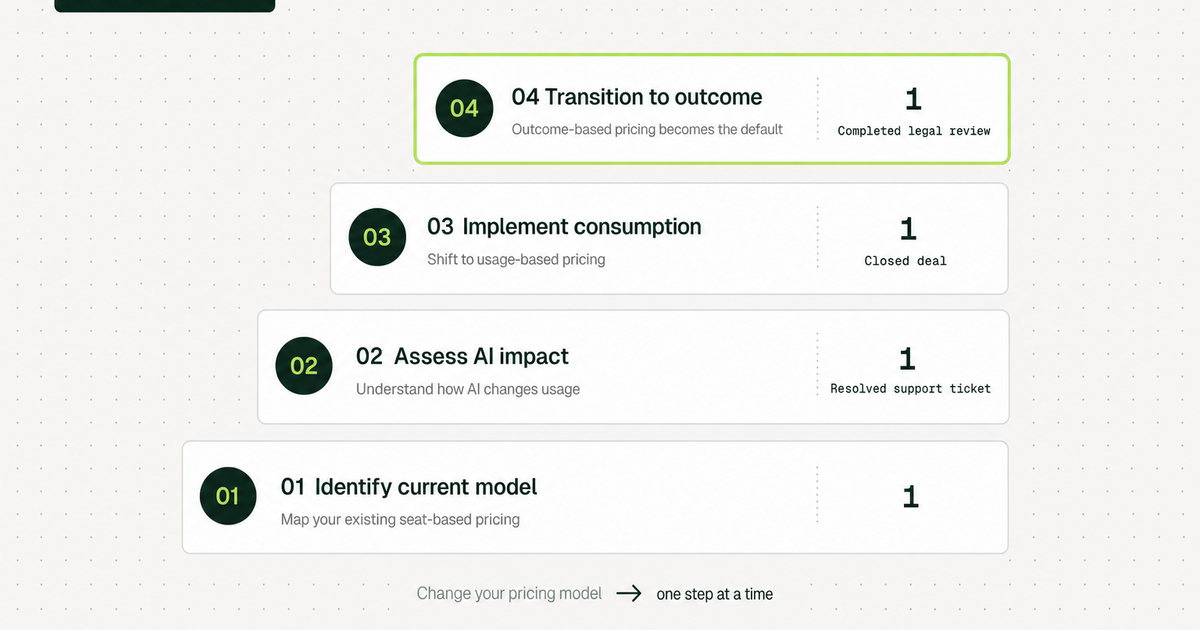
Over three days in San Francisco, we ran a series of monetisation workshops with founders and operators from some of the most interesting AI companies in the market. The sessions were led by Madhavan Ramanujam (ex Simon-Kucher) and Manny Medina (Paid.ai CEO & Founder), hosted in partnership with Lightspeed Ventures, Emergence Capital, and Sequoia Capital, and the same questions kept coming up in every room.
That's a signal worth paying attention to.
Here's what we took away.
Everyone is asking about credits. Nobody feels confident about them yet.
The move from seat-based SaaS pricing to credit-based AI monetisation is the defining commercial challenge for AI-native companies right now. Every founder in every session understood that the old model was breaking. But most were wrestling with the same underlying tension: credits feel right in principle, but they're hard to make concrete in practice.
How do you explain the value of a credit to a customer who has never bought one before? How do you set the price? What happens when costs fall? Can you change the value of credits after launch? These questions came up so consistently across all three workshops that we're going to write a dedicated post addressing each one. Watch this space.
The seat model is breaking down — and here's why
Traditional SaaS pricing assumed that value scaled with human headcount. More users, more seats, more revenue. It was a clean model for a world where software augmented human work.
AI changes the underlying assumption. Agents don't need seats. They consume compute. And the value they deliver — whether that's resolving a support ticket, generating a contract, or running a negotiation — is not linearly related to the number of humans involved.
As AI agents reduce the need for human headcount in workflows, pricing per seat starts to misrepresent the value exchange entirely. Companies that hold onto seat-based models will increasingly find themselves in a race to justify pricing that no longer reflects what they actually deliver.
Why credits work
Credits solve the core problem of AI monetisation: how do you price something that does different things at different costs with different levels of value, across an ever-expanding set of workflows?
The answer is a single fungible unit that abstracts away the complexity underneath.
A credit doesn't price a specific task. It prices AI work — however that work is defined, whatever agent performs it, and regardless of the underlying compute cost. This gives you four critical advantages:
Flexibility. New features and capabilities can be added without renegotiating contracts. Credits absorb the complexity of product expansion.
Predictability for customers. Credit bundles give buyers something they can budget against. Paired with spend caps and real-time consumption visibility, they address the fear of unpredictable spend that causes decision paralysis.
Land-and-expand without friction. Power users buy more credits. There's no seat ceiling to negotiate through, no renewal conversation to have. Expansion happens naturally.
A path to outcome-based pricing. Credits are the bridge between where most companies are today — copilot mode, seat-adjacent — and where the market is heading: agents doing autonomous work priced on the outcomes they deliver.
One of the attendees in our sessions had already made this transition. Their revenue increased 60-70% after switching to a credit-based model. The transition wasn't frictionless — there was some churn as customers adjusted — but the commercial trajectory was unambiguous.
The Autonomy & Attribution Matrix
One of the most useful frameworks we shared across all three sessions was a simple two-by-two that maps pricing models to product characteristics.
The two axes are: how autonomous is the AI, and how attributable is its output to a specific outcome?
- Low autonomy + Low attribution → Seats based model. 'Set it and forget it'
- Low autonomy + High attribution → hybrid-based pricing. Usually seat based with credits provision.
- High autonomy + Low attribution → Usage-based pricing. Consumption as a value proxy. The AI is doing a lot, but it's hard to tie to a specific outcome.
- High autonomy + High attribution → Outcome-based pricing. The ideal end state.
Companies like GitHub Copilot and Cursor started in the bottom left and have been evolving toward the right. Sierra is already operating in the top right with fully custom, outcome-based pricing per customer. The matrix is useful not just for understanding where you are today, but for charting a credible path to where you want to be.
The hybrid transition: how to start without starting over
The most common concern we heard across all three workshops wasn't whether to move to credits — it was how to do it without breaking what's already working.
The answer is the 80/20 model. Keep your existing subscription pricing. Add an included credit allowance per seat. Design the allowance so that 80% of your customers stay comfortably within it. The remaining 20% — your power users — buy additional credits, creating a natural expansion motion without requiring a full pricing overhaul.
The goal isn't to change your price. It's to start building the association between credits and value in your customers' minds. Once that association exists, the conversation about credits becomes much easier — and expanding credit usage becomes frictionless.
Offering options also matters. Giving customers a choice between a fixed fee and a credit-based model — with a premium for the predictability of the fixed option — has been shown to increase ACV. Choice architecture creates anchoring effects that work in your favour.
How you communicate value is as important as the model itself
This came up in every session and it deserves its own emphasis. The best credit model in the world will fail if customers don't understand what a credit is worth.
The benchmark for value communication is Superhuman: "$30 a month is a dollar a day to get four hours of productivity back." It takes an abstract subscription price and converts it into a felt, daily exchange of value. Every AI company should be able to articulate the equivalent for their product.
The Human Value Equivalent (HVE) framework is a powerful tool for this in sales conversations. Framing credits in terms of human work displaced — and crucially, pitching against future hiring or BPO budgets rather than existing headcount — makes the value proposition concrete and separates the pricing conversation from cost entirely.
The question nobody has fully answered yet: what happens when software uses your software?
One of the most thought-provoking questions raised across the workshops was this: as agentic systems proliferate, what happens when it's not a human buying and consuming your product, but another AI system?
The traditional assumptions of SaaS — a human user, a human buyer, a human decision-maker — start to break down in a world where agents are orchestrating other agents. The procurement model, the value communication model, the relationship model: all of it changes.
The good news is that credits handle this transition gracefully. A credit doesn't care whether the consumer is a human or a system. It prices AI work, full stop. But the broader commercial and contractual implications of machine-to-machine consumption are something the industry needs to work through — and the companies that think about it now will be better positioned when it arrives at scale.
Where this is all heading
The long arc of AI monetisation ends at outcome-based pricing. Technology will increasingly function like an insurance carrier — underwriting the delivery of specific outcomes, and carrying some form of liability if those outcomes aren't delivered. We're not there yet, and most companies are right to focus on the hybrid transition rather than trying to leap to outcome-based models before they have the data or the trust to support it.
But the direction is clear. Credits are the currency that makes the journey possible.
The most important thing you can do right now is start. Add credits to your packages today — even modestly — so that the association between credits and value is already established by the time you're ready to have the bigger commercial conversation later this year.
The companies that build those foundations now will set the commercial standard for the next decade of software.
Paid helps AI-native companies design and implement credit-based monetisation models. If you'd like to run one of these workshops with your team, get in touch.
Stay ahead of AI pricing trends
Get weekly insights on AI monetization, cost optimization, and billing strategies.
Monetize AI Without the Headache
The billing platform built for AI companies. Launch pricing models, track costs, and optimize margins—no engineering lift.
- Track AI costs by model & customer
- Launch usage-based pricing fast
- Know your margin on every deal
- Integrate in minutes