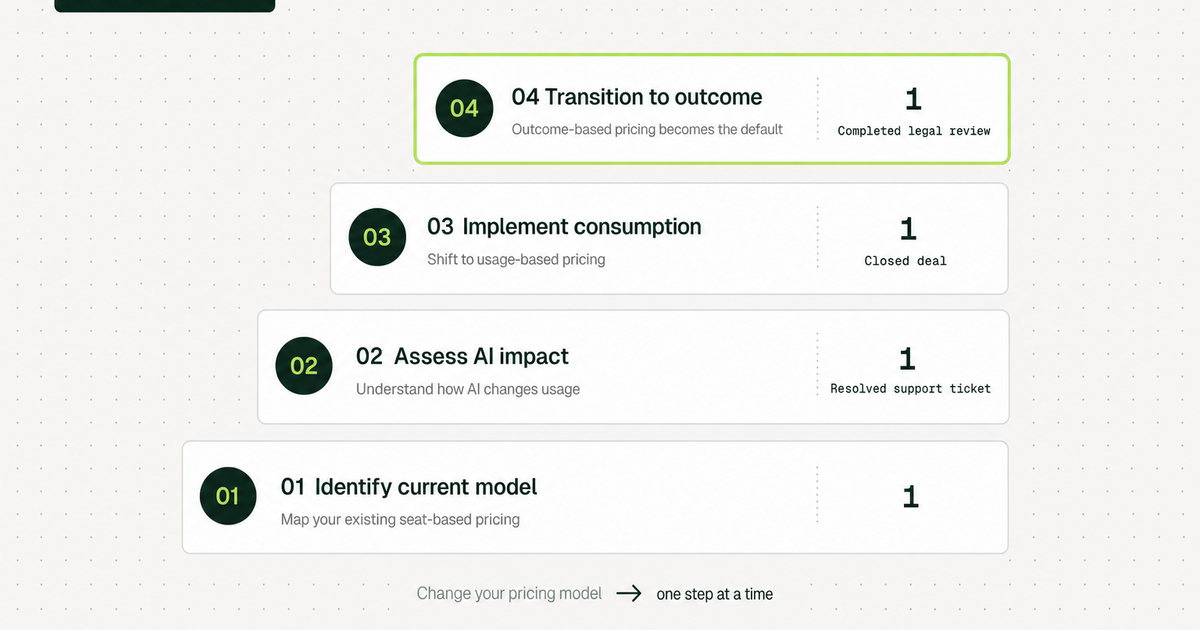
We ran three monetisation workshops in San Francisco this week with A16z, Battery Ventures and General Catalyst. Thirty plus founders. Dozens of questions. Here are the five that came up the most, and what we think the answers actually are.
1. "Should we move to credits when our competitors are still on simple, flat pricing?"
This was the tension that opened the Battery session and never fully went away. The concern is real: if a competitor can walk into a sales meeting and say "it's just $X per seat, no complexity," does a credit model put you at a disadvantage?
Simplicity is a genuine commercial asset, and we don't want to dismiss it. But the risk calculus is asymmetric, and it cuts the other way.
Every time you ship a new AI capability under a flat pricing model, you face the same problem: how do you capture value from it without renegotiating every customer contract? You can't. The seat model doesn't expand naturally. Credits do.
The answer isn't to make your pricing complicated, it's to make the complexity invisible. The 80/20 model is the practical path: keep your existing subscription, add an included credit allowance, and design it so the vast majority of customers stay comfortably within it. Most buyers never have to think about credits at all. Your power users, the ones getting the most value, expand naturally by buying more. You look simple from the outside. You're structured for frictionless growth on the inside.
The companies that build this foundation now will be expanding into every new workflow they ship without a single contract conversation. The ones that stay on flat pricing will be renegotiating every time.
2. "How do we figure out how many credits to charge for each task or outcome?"
This is almost always the first implementation question and there's a consistent temptation to over-engineer it.
Don't. Start with t-shirt sizing: small tasks, medium tasks, large tasks, XL tasks. Assign relative credit weights to each tier based on the complexity and value of the work involved, not on your underlying compute cost. An NDA review might be 3 credits. A full contract assessment might be 200. The absolute numbers are less important than the internal consistency: customers need to feel that the ratio between task types makes intuitive sense.
There's an important psychological principle at work here too: the denomination itself matters. 100,000 credits feels abundant and generous. 100 credits feels stingy, even if the purchasing power is identical. Design your credit amounts to feel like something worth spending.
And when you're in a sales conversation, don't lead with the credit number at all. Lead with the human equivalent. "This is the equivalent of two senior analysts working full-time for a quarter" lands in a completely different way than "you're buying 50,000 credits." Customers don't buy compute. They buy outcomes. Translate accordingly.
Over time, as you accumulate consumption data, you can refine your credit pricing with precision. But don't wait for perfection before you ship. Start with t-shirt sizes. Iterate from there.
3. "How do we handle usage that's wildly variable across our customer base?"
Several founders in the room had the same structural problem: some users consume ten times more than others, sometimes a hundred times more, making per-seat and per-usage models both feel inadequate. If you price on the low end, heavy users are a bargain. If you price on the high end, light users feel overcharged.
The reframe that resolves this: stop pricing usage and start pricing outcomes.
The number of queries, searches, or API calls a customer runs is not what they're buying. What they're buying is what those queries produce, the intelligence surfaced, the decision enabled, the outcome delivered. And that is far less variable than the usage that produces it. Two customers might run wildly different numbers of searches to reach the same business outcome. If you price on the outcome, the variability in usage becomes a cost management problem.........your problem, rather than a pricing problem you pass to the customer.
This is the fundamental reframe of outcome-based pricing. It requires you to invest in attribution, building the ability to demonstrate what your AI actually delivered, but that investment pays back many times over in pricing power and customer trust.
4. "What do we do with overages, rollovers, and unused credits?"
These questions came up repeatedly across both sessions, and they're really asking the same underlying thing: how do you design the mechanics of a credit model to feel fair to customers while still creating the right commercial incentives for expansion?
On overages: don't penalise them. Overage fees send exactly the wrong signal, "you used too much of something we sold you." Instead, quote 70–80% of expected usage at contract time. Set your customers up to succeed and slightly exceed their commitment. Treat the moment a customer approaches their credit limit not as a billing event, but as an expansion signal, a proof point that the product is working hard enough to warrant more.
On rollovers: design for roughly 80% utilisation with a 20% buffer. That buffer creates goodwill and gives customers headroom. But unlimited rollover removes one of the most valuable touchpoints in the customer relationship: the natural conversation that happens when a customer is approaching their limit. A customer drawing down credits quickly is your best upsell. Unlimited rollover means that conversation never happens.
The underlying principle: every credit mechanic should be designed to make the customer feel like they're winning, while creating natural moments for the commercial relationship to deepen.
5. "How do we operationalise all of this — the ledger, the customer success motion, the sales comp?"
This cluster of questions came up in both rooms and it's where the rubber meets the road. A great credit model on paper fails if the operational infrastructure isn't there to support it.
The credit ledger. Customers need real-time visibility into how their credits are being consumed, which workflows are drawing them down, and what value has been delivered. Without this, credits feel like a black box, and a black box erodes trust faster than almost anything else. You need an independent telemetry layer that tracks consumption at the task level and surfaces that data transparently to both customers and your internal teams. This isn't optional. It's the foundation of the commercial relationship.
The customer success motion. Under a credit model, the CSM role shifts from retention to ROI attribution. The job is no longer "prevent churn and manage renewal". It's "prove the credits are delivering measurable value, surface the data, and build the case for expansion." This means running value engineering audits roughly every six months, quantifying outcomes against what was promised, and having proactive conversations before credits run low rather than reacting after the fact. The CSM who can walk into a quarterly review with a clear ROI story doesn't have a renewal conversation. They have an expansion conversation.
Sales compensation. Sales comp must align with the pricing model or the whole system breaks. In a consumption-based world, reps should be incentivised on credit utilisation, and compensated for accuracy. A useful framework: tie a portion of sales comp to whether actual consumption lands within 10–20% of what was quoted. This aligns the rep's incentive with the customer's success, and creates accountability for the expansion conversation.
The question nobody has fully answered yet
Across both workshops, one question kept surfacing in different forms, and it's worth naming directly.
What happens when software starts buying your software, not humans?
As agentic AI systems proliferate, the assumption of a human buyer and human user starts to break down. AI is already orchestrating other AI. The procurement model, the value communication model, the legal framework, all of it was built for human actors.
Credits handle this transition more gracefully than any other model. A credit doesn't care whether the consumer is a person or a pipeline. It prices AI work, full stop. But the broader commercial and contractual implications of machine-to-machine consumption are still unresolved, industry-wide. The companies thinking about this now, and designing their credit models to accommodate non-human consumers will be significantly better positioned when it arrives at scale.
We don't have the full answer. But we think it's the most important question in AI monetisation right now, and we'll be writing more about it soon.
Paid makes it easy to launch and manage credit-based pricing; from configurable bundles and real-time consumption dashboards to automated top-ups and ROI reporting. Talk to us about adding credits to your product →
Stay ahead of AI pricing trends
Get weekly insights on AI monetization, cost optimization, and billing strategies.
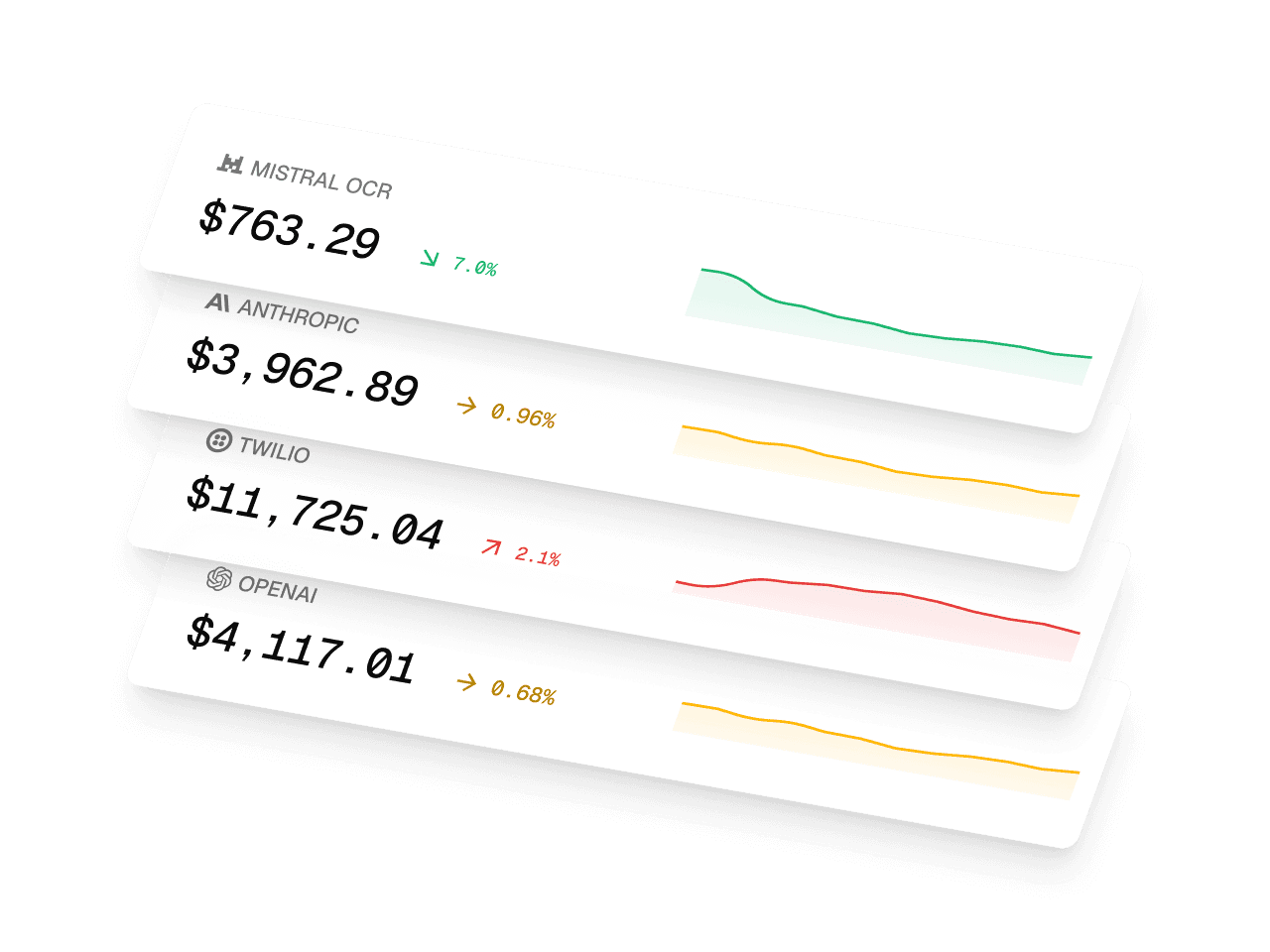
Monetize AI Without the Headache
The billing platform built for AI companies. Launch pricing models, track costs, and optimize margins—no engineering lift.
- Track AI costs by model & customer
- Launch usage-based pricing fast
- Know your margin on every deal
- Integrate in minutes