There's a paradox killing AI agent deals right now.
Your top performers - the ones who've been crushing SaaS quotas for years - are systematically undervaluing AI agents by 70-80%. Not because they're bad sellers. But because they're too good at what they've always done.
The comfortable prison of tools budget
Here's what I'm seeing: A seller demos an AI agent that can handle 80% of a support team's ticket volume. The buyer's eyes light up. The math is obvious - this could replace 8-10 FTEs or an entire BPO contract worth $800K/year.
But then muscle memory kicks in.
The seller pivots to ROI on Zendesk licenses. They position against the $50K tools budget. They close a $75K deal and hit their number. Everyone celebrates.
Meanwhile, $725K in value just walked out the door.
Why great sellers stay small
Upton Sinclair nailed it: "It is difficult to get a man to understand something when his salary depends upon his not understanding it."
Except here's the twist - their salary does depend on understanding it. They're just too successful to see it.
Your President's Club winners got there by mastering a specific discovery playbook:
- Find the pain in current systems
- Quantify the cost of inefficient tools
- Present your solution as a better mousetrap
- Close against the IT/tools budget line item
This playbook is so deeply ingrained that even when they're staring at a labor replacement opportunity, they reflexively steer the conversation back to software savings.
It's comfortable. It's predictable. It works.
And it's leaving millions on the table.
The new discovery map
AI agents don't just optimize workflows - they eliminate entire cost centers. Your discovery needs to match that reality.
Stop asking: "What tools are you using?" Start asking: "What work are humans doing that shouldn't require human judgment?"
Stop asking: "What's your software spend?" Start asking: "What's your fully-loaded cost per employee in this function?"
Stop asking: "Who owns the tools budget?" Start asking: "Who owns the P&L for this entire operation?"
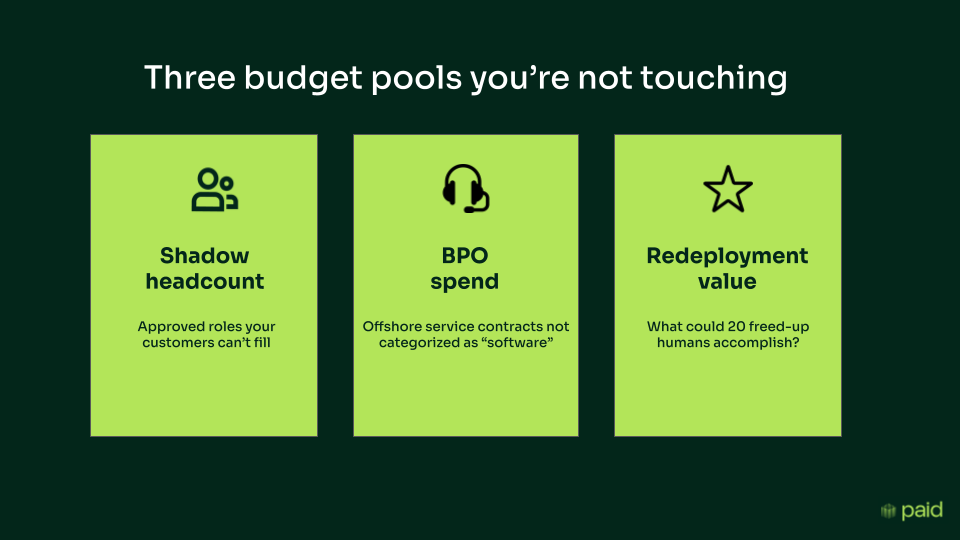
Three budgets you're not touching
1. The shadow headcount budget - Every department has approved headcount they can't fill or haven't filled yet. That's not in the tools budget, it's in the CFO's workforce planning model. An AI agent that eliminates the need for those hires is worth 10x the software it might replace.
2. The BPO/outsourcing spend - Companies spending $2M/year on offshore customer service aren't thinking about that as "software spend." But an AI agent that handles those interactions better, faster, and cheaper? That's a direct substitution play.
3. The redeployment opportunity - The highest-value positioning isn't even about cost reduction. It's about what happens when you free up 20 talented humans from repetitive work. What could they do instead? What new revenue could they drive? That value doesn't live in any tools budget.
Breaking the muscle memory
The hardest part isn't learning new discovery questions. It's unlearning the old ones when they've made you successful.
Here's my advice: Run two discoveries in parallel for your next three deals.
First, run your traditional SaaS discovery. Find the tools pain. Get to your usual number.
Then, run it again with a labor lens. Map the human work. Count the fully-loaded costs. Find the workforce planning owner.
Compare the two ACVs.
I guarantee the difference will break your addiction to the tools budget.
The choice
You can keep closing $50K deals against Salesforce licenses while your competitors close $500K deals against headcount.
You can keep having comfortable conversations with IT buyers while others are in the C-suite talking workforce transformation.
You can keep being successful in a shrinking pool.
Or you can evolve.
The market has already chosen. AI agents aren't tools—they're digital workers. Price them accordingly, or watch someone else do it.
Your commission check will thank you.
Stay ahead of AI pricing trends
Get weekly insights on AI monetization, cost optimization, and billing strategies.
Monetize AI Without the Headache
The billing platform built for AI companies. Launch pricing models, track costs, and optimize margins—no engineering lift.
- Track AI costs by model & customer
- Launch usage-based pricing fast
- Know your margin on every deal
- Integrate in minutes